

The use of methanol as an alternative marine fuel was pioneered by Methanex’s subsidiary, Waterfront Shipping, in collaboration with its shipping partners. Today, methanol is a safe, proven, and cost‑competitive marine fuel that can meet or exceed current and anticipated emissions regulations. With methanol storage available at more than 125 of the world’s largest ports, its adoption is accelerating as the shipping industry responds to increasingly stringent air emissions and greenhouse gas (GHG) requirements.
Why Methanol as a Marine Fuel?
| Emissions reductions | As a marine fuel, methanol can reduce emissions of sulfur oxides (SOₓ) and particulate matter by more than 95 per cent, and nitrogen oxides (NOₓ) by up to 80 per cent, compared to vessels operating on traditional heavy fuel oil. When produced from renewable feedstocks, methanol can also achieve significantly lower lifecycle GHG emissions. |
| A clear decarbonization pathway | Biomethanol and e‑methanol can comply with European Union FuelEU Maritime requirements and support the International Maritime Organization’s (IMO) ambitions to reach net‑zero emissions from international shipping by or around 2050, due to their low well‑to‑wake lifecycle emissions. |
| Safe and practical to use | As a liquid at ambient temperature and pressure, methanol can be safely transported, stored, and bunkered using procedures similar to those used for conventional marine fuels. Methanol is readily biodegradable and has relatively low ecotoxicity compared to petroleum‑based fuels. |
| Demonstrated fleet adoption | More than 70 per cent of Waterfront Shipping’s fleet vessels are now equipped with methanol dual‑fuel technology. Globally, more than 450 dual‑fuel methanol vessels are operating or on order, with the majority expected to be in service by 2030. |
Growing demand for methanol
Demand for methanol‑capable vessels is growing as methanol meets maritime GHG regulations, offers flexible fuel pathways, and is supported by existing infrastructure. Based on current orders, more than 450 methanol dual‑fuel ships are expected to be operating globally by 2030.
Methanol is one of the few fuels able to meet EU FuelEU Maritime and anticipated IMO regulations, which assess fuels on a lifecycle (“well‑to‑wake”) basis. The EU’s FuelEU Maritime requirements begin in 2025, and the IMO’s revised GHG Strategy targets net‑zero emissions from international shipping by or around 2050, with interim checkpoints for 2030 and 2040; targets that biomethanol and e‑methanol can help meet.
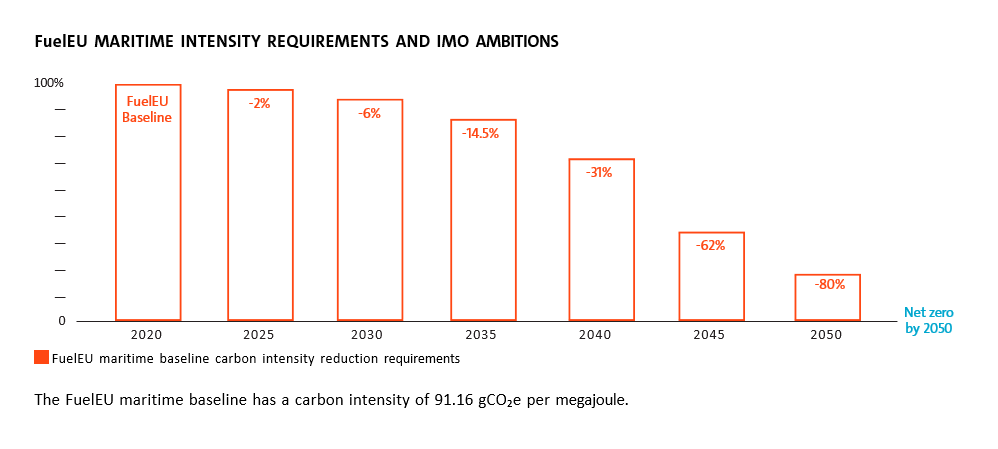
Figures in this graph are from https://www.zerocarbonshipping.com/fueleu
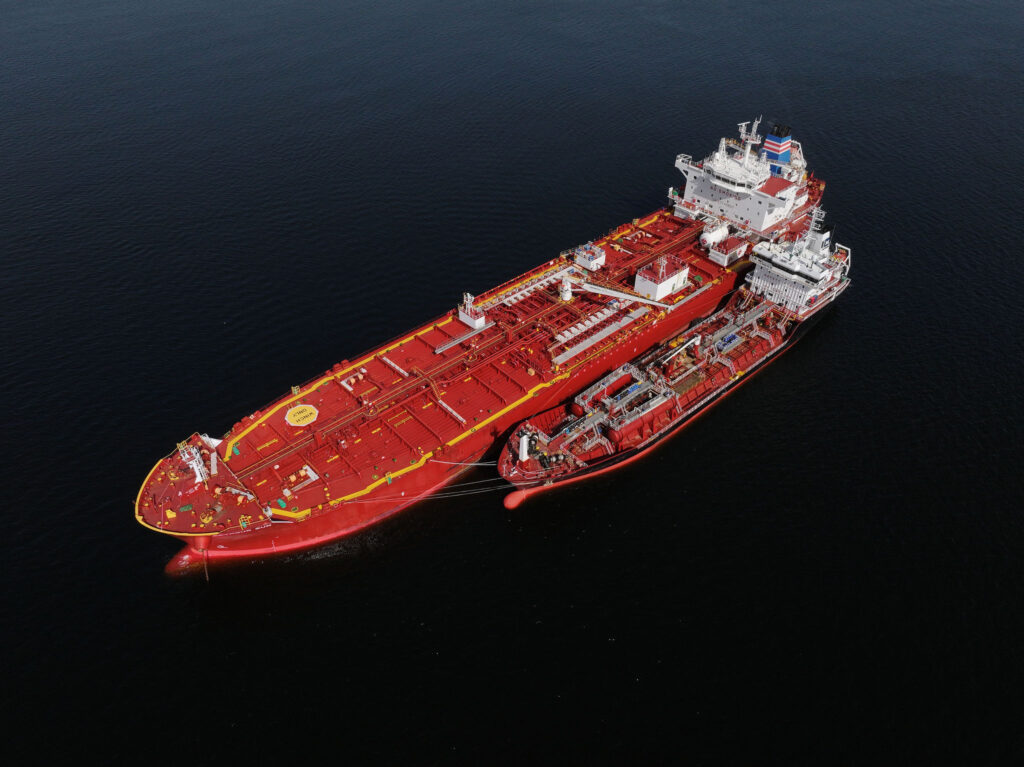
Demonstrating safe methanol bunkeringBunkering is the process of supplying fuel to ships. While global regulations for methanol bunkering continue to evolve, Methanex and Waterfront Shipping have demonstrated that methanol can be safely shipped, stored, handled, and bunkered using procedures similar to conventional marine fuels. Methanol can be bunkered via truck‑to‑ship, barge‑to‑ship, or ship‑to‑ship methods. In recent years, Methanex has focused on ship‑to‑ship and barge‑to‑ship bunkering and on advancing safety guidance and technical standards to support wider industry adoption. RIGHT// In 2024, the methanol‑powered Seymour Sun during the Caribbean’s first ship‑to‑ship methanol bunkering demonstration at the Port of Point Lisas, Trinidad and Tobago. This was made possible through collaboration with the National Energy Corporation of Trinidad and Tobago Limited (National Energy). |
 |
To learn more, visit pages 21, 25 to 26 of the 2025 Sustainability Report.